


IMAGE: Josh Chadwick/AFL Photos
The VFL finals kick off this weekend with the two wildcard clashes. Sydney (7th) hosts Frankston (10th) in the first wildcard final, while Williamstown (8th) faces off against Carlton (9th).
The winners from these matches will progress to the elimination finals. The highest-placed wildcard winner will play Port Melbourne, and the lower-placed victor will play Essendon.
Geelong, Werribee, Box Hill, and Tasmania also have the week off before the “normal” part of the finals begin, with the Cats squaring off against the Devils and the Bees doing battle with the Hawks.
Coburg, Greater Western Sydney, Southport, Footscray, St Kilda, Collingwood, North Melbourne, Brisbane, Casey, Sandringham, Richmond, and the Gold Coast finished outside the top 10 and did not qualify for finals.
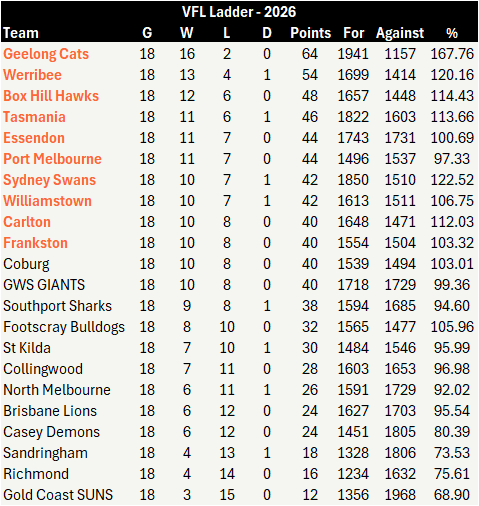
The top ten is equally split between reserves/affiliate sides from the AFL and standalone teams (for the purposes of this exercise Tasmania are counted as the latter as they currently do not have a “senior” side playing in the AFL).
Over the course of the season, I’ve been curious about the records of reserve/affiliate and standalone sides if you consider how they have performed in matches against clubs that do and do not fit into the same category as them.
A key driver behind this curiosity has been the uneven nature of the VFL fixture. It’s a strange beast, with 22 teams playing 18 games over 21 rounds. Not every team plays each other once, there are double ups between teams, and multiple byes spread throughout the season.
For example, Carlton’s VFL side played Footscray and St Kilda twice each, didn’t play Frankston, Port Melbourne, Sandringham, Southport, or Sydney, and had a bye in Rounds 1, 12, and 17.
Werribee, on the other hand, played Port Melbourne, Sandringham, and Tasmania twice, didn’t play Box Hill, Casey, GWS, North Melbourne, Richmond, or Sydney, and had byes in Rounds 8, 13, and 18.
And let’s not forget, the mid-season draft gives AFL clubs a one-off opportunity to add state-league players to their lists during the season, which can significantly impact how the sides that lose players perform for the rest of the year. Geelong, Williamstown, and Tasmania all lost two players, while in the SANFL Woodville-West Torrens lost three and North Adelaide two.
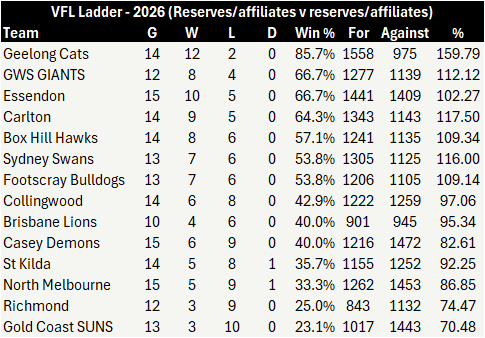
Let’s start by considering the games where reserve/affiliate teams play other reserve/affiliate teams. Note that the following tables are sorted by the percentage of games won due to the uneven fixture.
The order is broadly consistent with the overall ladder, which makes sense given all reserve/affiliate sides played more than half of their games against other sides from this level.
Geelong maintains their position at the top of the tree, having won 85.7% of their games against AFL-aligned sides in 2026, while Richmond and the Gold Coast have had challenging years in the second-tier competition, each winning only three games against this group of opposition.
But the side that stands out the most from this particular analysis is GWS, who missed the top 10 despite winning two thirds of their matches against other reserve/affiliate sides this season – including wins against finals sides Box Hill, Essendon, and Carlton. The GWS result is particularly interesting, given how their senior side as struggled with injuries throughout the year.
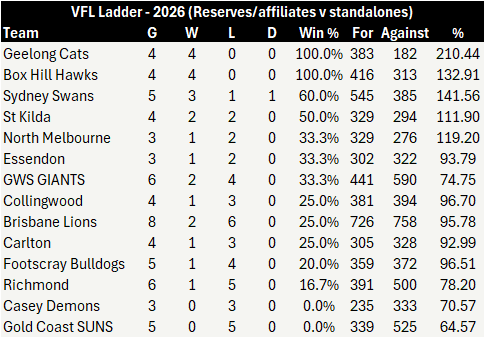
Two reserve/affiliate sides had perfect records against standalone clubs this season, with Geelong and Box Hill both going four from four. On the flip side of things, Casey and the Gold Coast both went winless against standalone clubs this year (the former going 0-3 and the latter going 0-5).
As we can see, the majority of AFL-aligned clubs won less than half of their games against standalone sides. Carlton’s good form against other reserve/affiliate sides was enough to help it sneak into finals. The Blues lost to Coburg, Werribee, and Williamstown but managed a win against Tasmania – which is more than can be said for Gold Coast, GWS, North, Richmond, and Sydney.
Werribee, Tasmania, and Coburg had the best winning percentage for matches against other standalone teams, although Werribee and Tassie have their noses in front of the Burgers as the Tigers and the Devils drew when the sides met back in Round 7.
Sandringham struggled in their first season as a standalone club after St Kilda chose to field their own reserves side for 2026, going 2-7-1 against other sides of a similar ilk.

Frankston seem to have done the opposite of GWS this season and have had significantly better results against reserve/affiliate sides (7-1) than against other standalone teams (3-7). However, this should give the Dolphins confidence heading into finals, as the only AFL-aligned side they lost to this year was Geelong the minor premiers.

The debate about how to best structure a reserves competition for AFL sides took another turn during the past week, with the Port Adelaide Magpies announcing they will exit the SANFL after the 2028 season.
“We need to make sure that that program is giving us the best chance to develop our AFL players in the best capacity,” Port Adelaide’s chief executive Matthew Richardson said on SEN over the weekend.
“It is the players you play with. If you look at all the other AFL teams that are operating in other competitions, the quality of the players that they’ve got around their young players is at a very different level of what we are able to do.”
Adelaide, the other South Australian-based AFL team, currently has its own reserves side playing in the SANFL.
Fremantle, who are aligned with Peel Thunder in the WAFL, have previously been reported as objecting to a national reserves competition.
I’m not sure what the best outcome here is. There are financial and logistical challenges associated with having a league featuring only the AFL reserves.
But the VFL is no longer truly the VFL, after its 2020 expansion saw it absorb the NEAFL, which served the ACT, New South Wales, Queensland, and the Northern Territory. Aspley – the other Queensland club that joined the VFL – has since left the league.
Adding the two South Australian clubs would take the league to 24 teams and bring about its own challenges, least of which would be having something that resembles an equitable fixture.
Perhaps a national reserves competition is the way to go – especially if it means historic standalone clubs are allowed to continue to exist in the VFL.
There was much disappointment when Preston was stripped of its VFL licence after the 2025 season, which suggests the AFL are more likely to thrown money at making a national reserves competition than supporting non-AFL-aligned teams.
Certainly a space to watch in the coming years.
Firstly, really admire the Frankston story, what they’ve been through as a standalone club the last decade or so.
Secondly, surely the end goal is a national reserves comp, all 18 teams, one comp, purely reserves teams, aligned to the AFL comp and its fixtures, clean, efficient, beneficial.
Then you consolidate your secondary pathways, that would be the WAFL and SANFL as they once were, no more AFL reserves integration, and then if possible a reborn VFL comp, Port Melbourne, Williamstown, Frankston, et al., can a 10-12 team comp of standalone VFL teams be sustainable, I hope so. Plus what you might do with the newly formed SFL, Queensland, etc.
Anything short of that feels all varying levels of compromise and inefficient to me.