


North Melbourne’s Harry Sheezel polled 27 votes over the course of Monday night’s Brownlow Medal count – the highest total by any Kangaroo since Ross Glendinning won the award in 1983 with 24. Sheezel’s haul also equals the all-time record set by Keith Greg, who won the Brownlow in 1973 and 1974.
Sheezel, who finished in a three-way tie for fifth with young Lion Will Ashcroft and two-time Brownlow Medallist Patrick Cripps, polled in six of his first seven games before missing out completely in the next five.
However, the third overall pick in the 2022 National Draft came home strong, recording consecutive best on ground performances in Rounds 14, 15, and 16 before also picking up votes in four of the last seven matches.
The 21-year-old essentially doubled his career vote tally, having accrued 28 votes over his first three seasons: three in 2023, 15 in 2024, and 10 in 2025.
There are plenty of potential explanations as to why the Sheez experienced such a jump this season, and it’s more likely than not that there isn’t just one reason.
It could be that North were more successful this year than at any other point in Sheezel’s career – tasting victory in nine games after seasons of three, three, and five and a half wins – given the fact that players from teams that win (more) games typically poll better than teams at the bottom of the ladder.
It could also be that the four field umpires had access to certain statistics during the voting process this year, unlike years gone by. Disposals were one of the 17 stats umpires could view while casting the Brownlow votes, and only three players – all of whom played finals – averaged more disposals than Sheezel’s 30.4 in 2026: Nick Daicos (34.7), Bailey Smith (32.3), and Errol Gulden (32.0).
(And if you’ve already forgotten, Daicos won the Brownlow with a record number of votes, Smith polled enough votes that he would have won every before 2024, and Gulden had five consecutive best-on-ground performances to finish the season after missing 12 rounds of football through injury.)
But in looking at the difference between the expected and actual votes players receive, along with the quartet of field umpires who adjudicated each game – which is something I’ve done for the past two seasons (see here, here, and here for previous stories on this topic) – I’ve identified another possible explanation: certain umpires love “Sheezy Ball” more than others.
If you consider the player/umpire pairings that were involved in three or more games throughout the course of the season, the two pairings with the greatest (positive) difference between the predicted and the actual number of votes are Harry Sheezel with Justin Power (5.66 votes) and Cameron Dore (4.83 votes).
These discrepancies remain when you consider the average difference to account for the varying number of games between pairs of players and umpires and are pretty stark: the four games where Sheezel played and Power officiated saw Sheezel receive an average of 1.42 votes above expectation per game, while the five games with Dore resulted in Sheezel polling an average 0.97 votes above expectation per game.
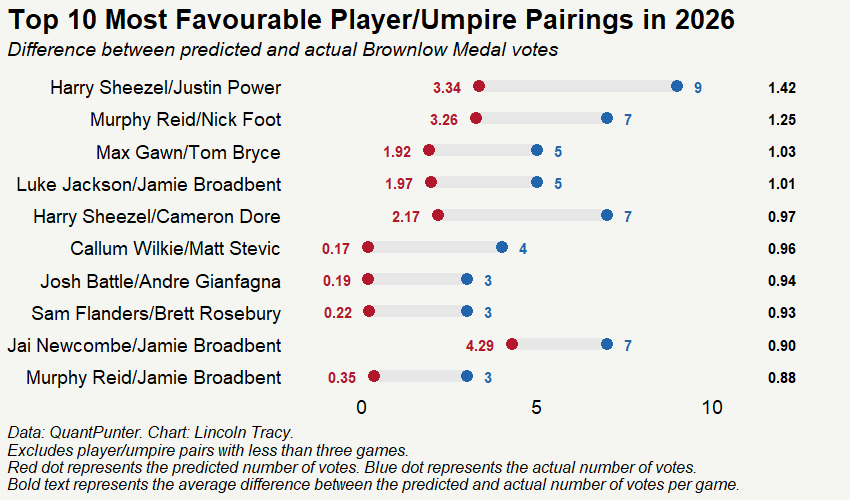
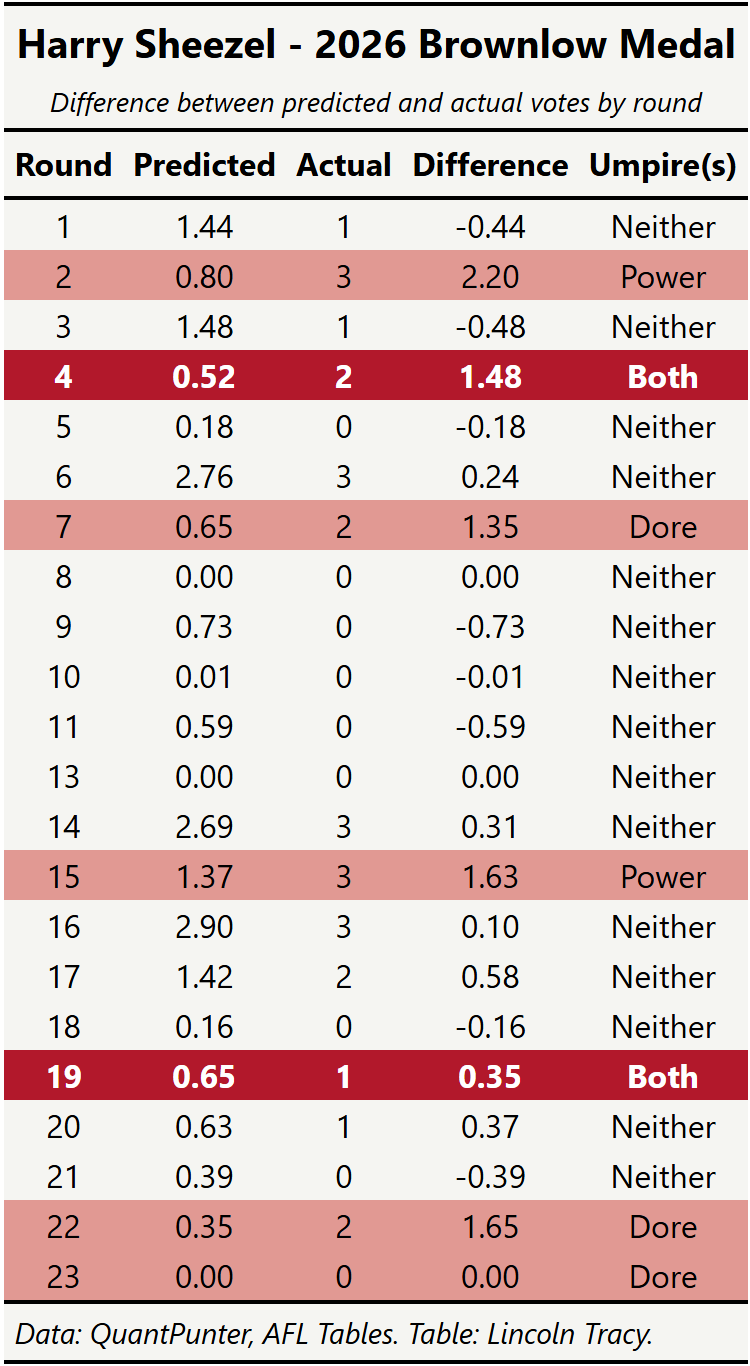
Breaking things down on a round-by-round basis confirms the games involving Power and/or Dore had a greater discrepancy between the predicted and actual votes than the other games where they were not officiating. There were seven games where at least one of Power or Dore were umpiring. Sheezel polled at least 1.3 votes more than he was expected to in five of these seven, including the Round 4 Good Friday SuperClash against Carlton.
Both Power and Dore were out there that day, with Sheezel receiving two votes from the umpires in the Kangaroos’ 10-point win following his 24 disposals, seven contested possessions, seven score involvements, six clearances, four inside 50s, and a goal. He was predicted to poll 0.52 votes, behind Luke Davies-Uniacke (1.74), Caleb Daniel (1.46), and Dylan Stephens (0.74) in a game that didn’t have a clear standout for best on ground. Furthermore, Sheezel was not one of the eight players – and five Kangaroos, including Davies-Uniacke, Daniel, and Stephens – to feature in the coaches’ votes.
But North’s Round 2 clash, involving Power, is potentially the most egregious example of the difference between the predicted and actual votes. Playing against West Coast in Round 2, Sheezel collected 39 disposals, 14 contested possessions, eight clearances, five inside 50s, four tackles, and 612 metres gained as the Kangaroos went down by 17 points. However, his disposal efficiency was only 66.7%, and a similar proportion of his disposals came in North’s defensive half of the ground.
Harley Reid, who received two votes from the umpires after putting up 30 disposals, 11 contested possessions, three clearances, five tackles, and 387 metres gained, also received the maximum number of votes from both coaches. Dejan Kalinic at AFL.com.au was quick to point out that Sheezel was one of eight players who received the three Brownlow votes from the umpires but got no love from the coaches (in terms of the coaches’ votes) in a particular game.
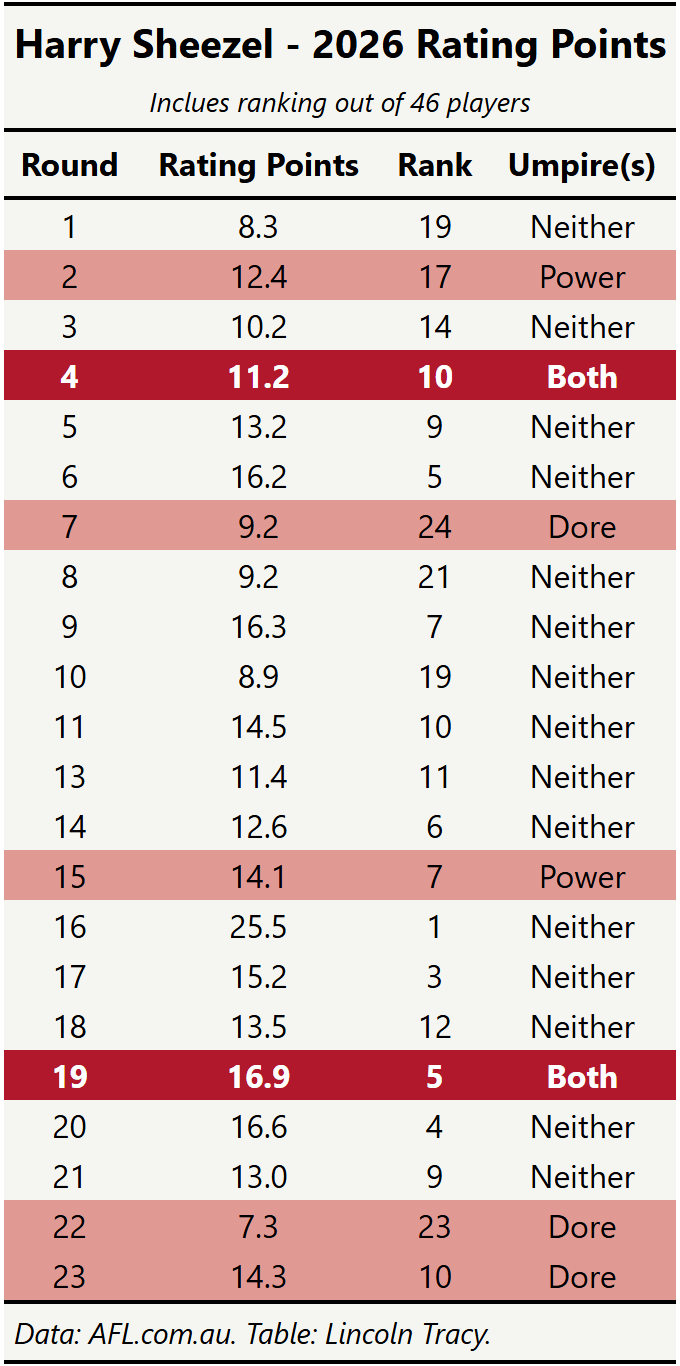
If you want more evidence, let’s look at Sheezel’s rating points over the course of the season and how the votes shook out. He was the 17th ranked player when he took the three votes in Round 2, the 24th ranked player in Round 7 when he received two votes, and the 23rd ranked player when he received another two votes in Round 22. Sheezel was not ranked in the top 3 for any games involving Power and/or Dore and was only in the top 5 on one occasion: Round 19, where we received one Brownlow vote.
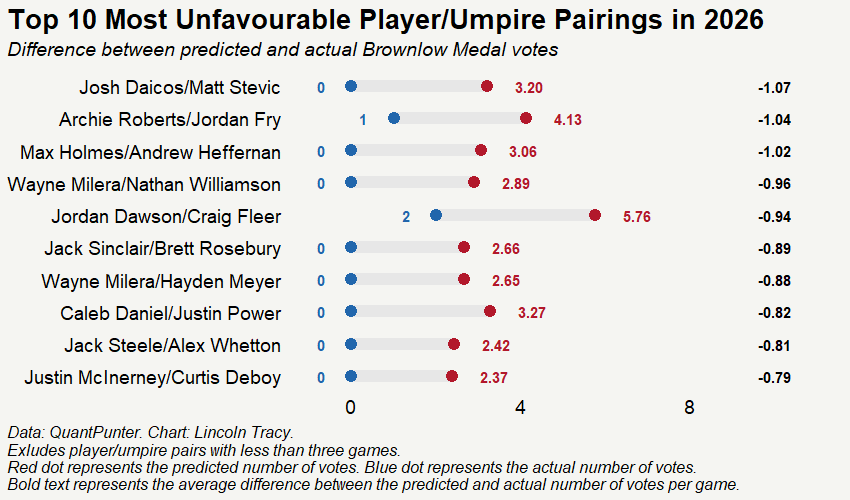
And while you’re considering all of that, take a moment to consider Sheezel’s teammate Caleb Daniel, who was potentially overlooked by Power throughout the season. The Daniel-Power pairing was one of the top 10 most unfavourable parings of 2026, where players received less votes than expected, although it was not as unfavourable as Josh Daicos with Matt Stevic, Archie Roberts with Jordan Fry, and Max Holmes with Andrew Heffernan.
Adelaide’s Wayne Milera also deserves some recognition, appearing in the top 10 list twice with Nathan Williamson and Hayden Meyer. Milera was All-Australian for the first time in his career this year and polled 54 coaches’ votes but did not hear his name called out on Monday night. The 54 votes is a new record for the most coaches’ votes in a season without then getting a Brownlow vote, per Swamp.
In case you missed it
Earlier this week the AFL Commission confirmed that clubs in both the AFL and AFLW would have the option to add an additional category B rookie to their list is of First Nations or Indigenous heritage.
The league, along with the players’ association, view the decision as a way of stopping the declining number of First Nations players at the top level. But not everyone is convinced.
Last month I had the opportunity to speak to Eddie Betts, Andrew McLeod, and Leon Davis – all champions of the game – about their views on the introduction of a dedicated list spot for First Nations talent, and whether this was the “best” way of increasing Indigenous involvement in the AFL and AFLW.
Find out what Eddie, Andrew, and Leon had to say in my piece for Perceived Pressure:

Preview image credit: Dylan Burns/AFL Photos
I wish you would write an American version of this so I could understand what the hell this is all about. Sounds very exciting though.